












https://youtube.com/shorts/drxbJ-SGv2I?si=jNYzN-v3pz7Dad9G
Sanding & De-Nibbing Black Primer on Aluminium Sliding Doors – Creating the Perfect Base for Final Coats
Focus Keyphrase: Aluminium window painting Gold Coast
Slug: sanding-de-nibbing-black-primer-aluminium-sliding-door
Tags: Aluminium window respraying, Window frame painting, Sliding door repainting, Surface preparation, Gold Coast
Key Points of This Post
Why sanding (de-nibbing) primer is critical in aluminium window painting
What “nibs” are and why they appear
The difference between rough primer and a refined primer surface
Why primer sanding affects final gloss and durability
The step-by-step sanding process
The Video – Sanding Black Primer on a Sliding Door
In this job, the primer coat had already been applied to an aluminium sliding door frame. The primer was black — chosen to provide depth and uniformity beneath the final colour.
What the video shows is not spraying.
It shows the stage most people never see.
The sanding.
The de-nibbing.
The refining of the primer surface before final coats are applied.
And this stage determines everything about how the finished door will look.
Why Primer Is Not the Final Surface
Primer has one job:
Adhesion and build.
It bonds to the prepared aluminium and creates a consistent substrate for the final coats.
But primer — especially high-build or adhesion-promoting systems — can leave:
Minor texture
Dust nibs
Overspray grain
Slight surface roughness
Raised fibres from contamination
That is normal.
Primer is not designed to be perfect.
It is designed to be sanded.
What Is “De-Nibbing”?
De-nibbing is the process of lightly sanding the primer to remove surface imperfections without cutting through the film build.
A nib is:
A tiny dust particle
A small bump
A raised fragment
A dry spray grain
These are microscopic but visible once top coats are applied — especially in darker colours or gloss finishes.
If you skip de-nibbing, you lock those imperfections under the final coats.
Why This Stage Matters More Than People Think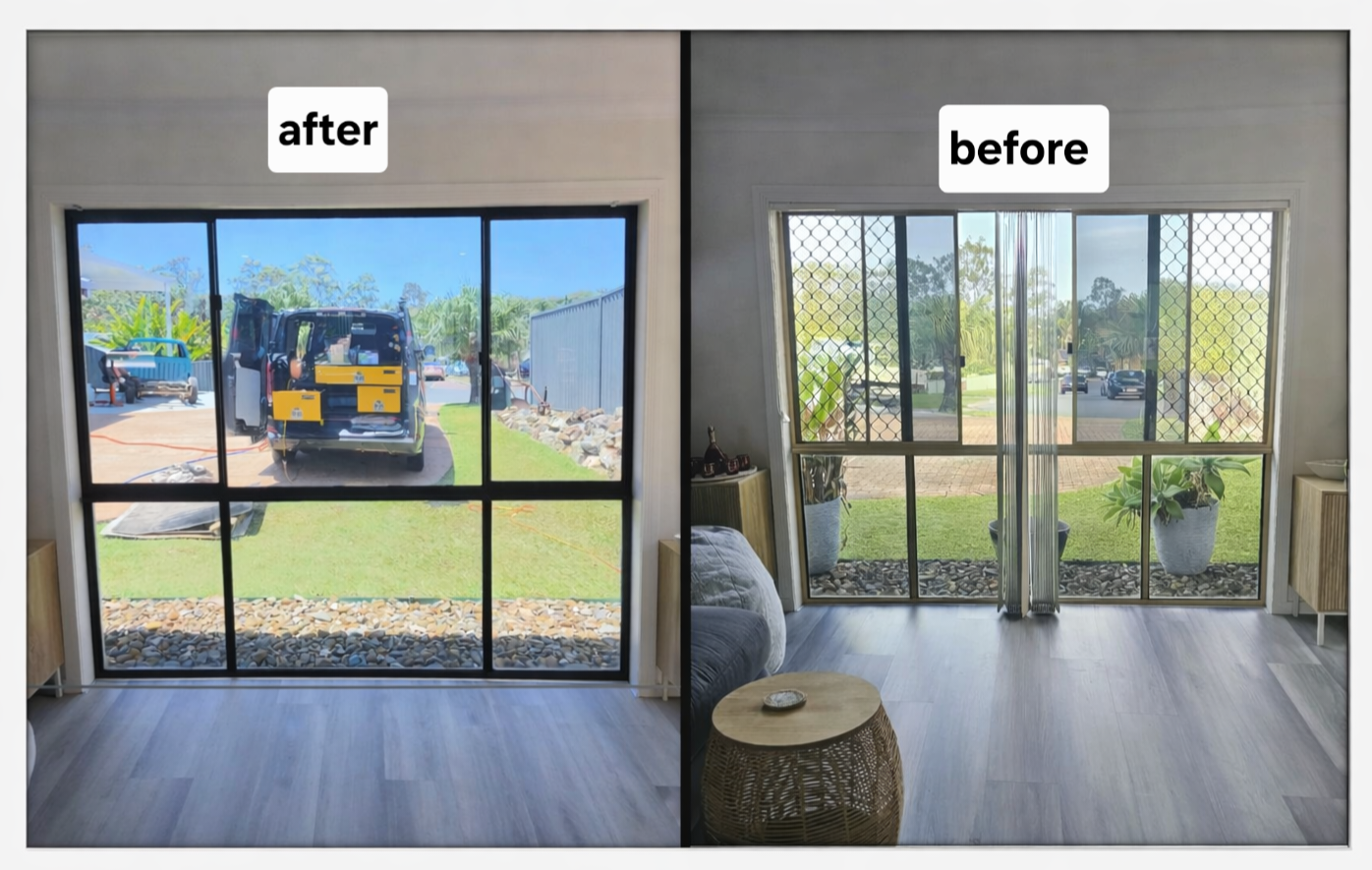
Most homeowners assume the magic happens during spraying.
It doesn’t.
The magic happens between coats.
The smoother the primer surface, the smoother the final coat lays.
Paint does not hide imperfections.
It magnifies them.
Especially when sprayed.
The Sliding Door – Why It Needs Extra Attention
Sliding doors differ from fixed windows because they include:
Large flat faces
Horizontal rails
Vertical mullions
Internal channels
Track edges
Corners that catch dust
These surfaces reflect light strongly.
Any imperfection becomes obvious once final coats are applied.
Sanding primer on a sliding door is about:
Creating uniformity
Removing raised particles
Leveling the film
Ensuring consistent sheen
Step 1 – Confirm Proper Cure
Primer must be cured before sanding.
If sanded too early:
It balls up
It tears
It loads the abrasive
It smears
In the video, the primer was allowed to fully flash and harden before de-nibbing began.
Timing matters.
Step 2 – Choosing the Correct Abrasive
Primer sanding is not aggressive stripping.
It is refinement.
The abrasive must:
Remove nibs
Flatten texture
Preserve film build
Too coarse = risk of cutting through
Too fine = ineffective surface leveling
The goal is controlled dulling of the entire surface.
Every square centimetre must be evenly abraded.
Shiny spots indicate missed areas.
Step 3 – Controlled Hand Sanding
In this project, sanding was done carefully by hand.
Why hand sanding?
Because aluminium frames have:
Corners
Tight edges
Recesses
Rounded profiles
Machine sanding can:
Burn edges
Cut through primer
Leave swirl marks
Hand sanding allows:
Pressure control
Edge awareness
Even feathering
Step 4 – Avoiding Burn-Through
Burn-through is when sanding cuts through the primer back to bare aluminium or original coating.
If that happens:
Adhesion can be compromised
Spot priming may be required
Film build becomes inconsistent
Proper technique avoids this.
Pressure must be:
Light
Controlled
Even
Edges require special care.
Edges are where film thickness is naturally thinner.
Step 5 – The “Uniform Dull” Test
After de-nibbing, the entire surface should appear uniformly dull.
No gloss.
No shine.
No untouched sections.
This visual check confirms:
Proper keying
Full coverage
Consistent abrasion
If any shiny areas remain, the final coat may not bond optimally in that spot.
Step 6 – Cleaning After Sanding
Sanding creates dust.
Dust left behind becomes contamination.
The process includes:
Vacuuming
Wiping
Final solvent wipe
Tack cloth inspection
This ensures the final coat is laid over a contaminant-free surface.
Skipping this step introduces new nibs into the final coat.
Why Black Primer Shows Everything
Black primer is unforgiving.
It highlights:
Uneven sanding
Missed edges
Surface waves
Light scratches
But that is exactly why it is useful.
It allows imperfections to be corrected before final colour.
Once final coats go on — especially lighter colours — those flaws become harder to detect and fix.
The Science Behind Surface Smoothness
Paint reflects light.
The smoother the substrate, the more even the reflection.
Rough primer = uneven reflection = patchy finish.
Smooth primer = clean reflection = professional finish.
In gloss or satin finishes, this difference is dramatic.
What Happens If You Skip De-Nibbing?
If primer is not sanded:
Dust nibs telegraph through
Final coat texture increases
Sheen becomes inconsistent
Surface feels gritty
Edges look thick
Even if the colour looks good from 5 metres away, up close it lacks that factory feel.
And aluminium window painting is judged up close.
Why This Stage Is Rarely Filmed
Sanding primer is:
Quiet
Slow
Technical
Repetitive
It does not look dramatic on camera.
But it is one of the most important stages in the entire process.
That is why this video matters.
It shows the discipline behind the finish.
The Relationship Between Primer Sanding & Final Film Thickness
Proper sanding:
Removes surface defects
Maintains build
Prepares for layering
Primer thickness must remain within optimal film range.
Excessive sanding reduces protection.
Insufficient sanding reduces smoothness.
Balance is key.
Why Sliding Doors Require Extra Dust Control
Sliding doors include tracks and recesses that trap sanding dust.
If dust is not removed:
It migrates during spraying
It contaminates the top coat
It creates new nibs
Proper dust management protects the final stage.
Residential vs Commercial Systems
On residential aluminium window painting, specialised single-component systems are used.
Commercial projects may involve 2-pack systems, but this job was residential.
The sanding principles remain the same:
Smooth base = superior finish.
The Visual Difference After Final Coats
When the final coats are laid over properly de-nibbed primer:
The finish appears deeper
The surface feels smoother
The sheen is consistent
Light reflection is uniform
The door looks factory finished
This is not accidental.
It is engineered through preparation.
The Discipline of Professional Refinishing
Many painters:
Spray primer
Spray top coat
Skip refinement
That shortcut shows in the finish.
Professional aluminium window respraying includes:
Cleaning
Abrasion
Primer
Primer sanding
Final clean
Multiple top coats
Every stage builds on the previous one.
Why Sliding Doors Are a Focal Point
Sliding doors are often:
Large
Central
Highly visible
Frequently touched
They catch sunlight at different angles throughout the day.
A smooth finish enhances:
Perceived quality
Modern feel
Architectural sharpness
How This Impacts Durability
De-nibbing is not just cosmetic.
It improves:
Intercoat adhesion
Layer bonding
Film integrity
Long-term performance
Smooth surfaces allow better layering.
Layering creates protection.
What This Means for Gold Coast Homes
On the Gold Coast, aluminium frames face:
UV exposure
Coastal salt
Humidity
Temperature shifts
A properly prepared and layered system withstands these conditions far better than rushed work.
This sliding door now has:
Refined primer base
Even key
Clean substrate
Ready surface for final coats
The Bigger Picture
This video captures sanding.
But sanding represents something bigger:
Care.
Attention.
Process.
It proves that aluminium window painting is not about quick colour change.
It is about structured refinishing.
When You See the Final Result
Once the final coats are sprayed, most people will only see:
A smooth sliding door.
What they will not see:
The hours of sanding
The inspection process
The edge control
The dust removal
The methodical de-nibbing
But that invisible work is what separates average from exceptional.
Who Benefits From This Level of Process
Homeowners who:
Want long-term results
Appreciate detail
Value finish quality
Notice imperfections
Care about longevity
If someone is only looking for the cheapest quick spray, this level of prep is unnecessary.
But if the goal is factory-level smoothness — this stage is critical.
Final Thoughts
Sanding black primer on a sliding door might not look exciting.
But it is one of the most important parts of aluminium window painting.
It ensures:
Smooth final finish
Uniform sheen
Strong intercoat adhesion
Professional appearance
Long-term performance
The final coat is only as good as the surface beneath it.
And in this project, that surface was refined with precision.
Recap of Key Points
Primer must be sanded before final coats
De-nibbing removes dust and surface imperfections
Sliding doors require detailed edge control
Uniform dull finish confirms proper abrasion
Cleaning after sanding is essential
Smooth primer = smooth final coat
Skipping this stage reduces quality
This process improves both aesthetics and durability
Preparation determines the outcome
Aluminium window painting is a system — not a single spray pass.
And sanding the primer is one of the most important steps in that system.
